India, Traveling

Memories from Mumbai

India is about the people, not the architecture.

12th of February 2014

Dear diary,

We’re waiting in Mumbai’s Domestic airport for our flight to Coimbatore. Akila’s wedding is on the 17th and me and Milto are very excited to see everyone and try our new sarees on. Our three days in Mumbai were chaotic, exciting, refreshing but also sad. How people in the 21st century can still bring offerings at temples dedicated to zoomorphic gods, I cannot comprehend.

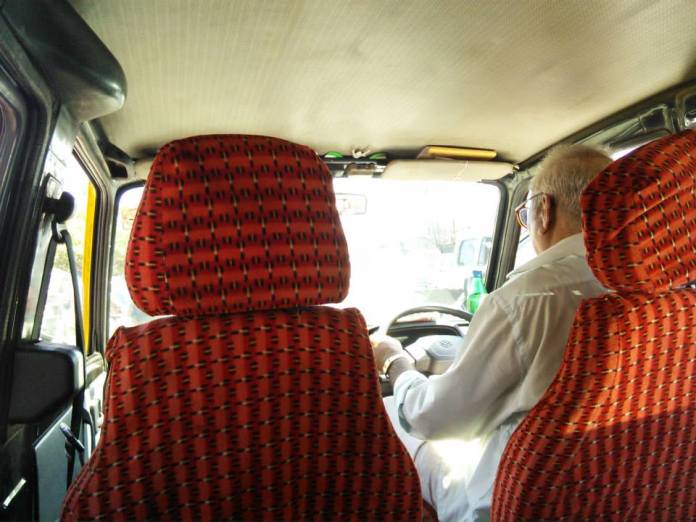
Coming from the airport on the 9th of February, we were greeted by three neatly dressed indians, who quickly grabbed our bags and led us to a cab. After managing to get away with offering them 100 rupees, the driver started off what seemed to be a 20th century car, which puffed methane gas on the dusty streets of Mumbai. The white haired driver advised us that 10 rupees would have been enough. He was rushing his rusty car through the crowded areas, filled with a range of terribly poor people, living in dark nylon tents. Some buildings were so old, there were plants coming out of the walls, tearing the stone apart.

pic1

“The old, white haired driver advised us that 10 rupees would have been enough.”

Children running around half naked, doing their buisness in front of the house, people carrying fruit in big baskets on their heads, colourful circus cars with images of vampires, scaring some indian ladies to a scream…”the slums” as they call it, where most of Mumbai’s population dwells, in utter, tragic poverty. The taxi driver quickly dismissed our judgement or, rather tried to, as he stated “third class”.

After about an hour, we reached the hotel and checked in. The entrance to the hotel was between two small shops and had 2 flights of stairs, which we had to climb with our 20kg suitcases. The receptionist was a tall, thin man with a black, brush-like moustache. He was very kind and reassuring and showed us to our room through one of the bell boys. He gave us the key with the inscription: “Please return to the reception for cleaning.”

The hotel consisted of one long corridor, filled with doors marked “Deluxe” or “Superior”. Milto and I got the “Deluxe” Olive suite, right next to the 1×2 square meter kitchen, where they made omelettes and sweet chai every morning. The corridor had an open side with a metal skeleton of flower motifs, oriented towards a sailor’s square. Every day at sunrise loud men would come to collect their sailing passes. They were one of the reasons I couldn’t sleep properly for the next 3 nights.

sailors

“At about sunrise, loud men would come to collect their sailing passes every day.”

We unpacked, with Milto having considerably more creams that I did and then went on a search for a sim card. The receptionist suggested the marketplace nearby. We stepped out into the loud, crazy street, where cars would honk every 5 seconds to get access in front of other cars. Scooters, three wheelers without windows, 20th century taxis would brush against each other almost like in an attempt to survive. People would cross the street fearlessly, taking advantage of the frequent traffic jams.

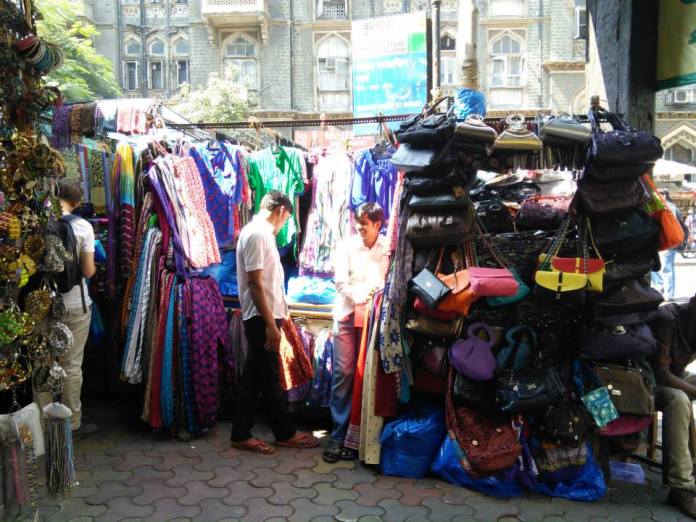
We managed to cross the street eventually as our European feet were a bit too cautious. We walked across the bridge over the railway station and reached the market. Hundreds of merchants were yelling “excuse me madam” and shoving electronics, silks, shoes and other forms of merchandise under our noses. Brightly coloured silk sarees, spices, fruit, toys, mobile phones, more mobile phones, but no sim cards, despite of the giant Vodafone sign in the middle of the square.

saree

“excuse me madam”

We walked for a bit, not knowing what to believe and then entered into what looked like a dirty, abandoned market space. We were soon greeted by three old locals who quickly rose from their slumber when seeing us. One of them was talking about how we should wear tags to keep our goods safe, another convinced us to follow him to where his friends sold spices. He was like the guide to where everything was in the little marketplace.

friends

“convinced us to follow him to where his friends sold spices”

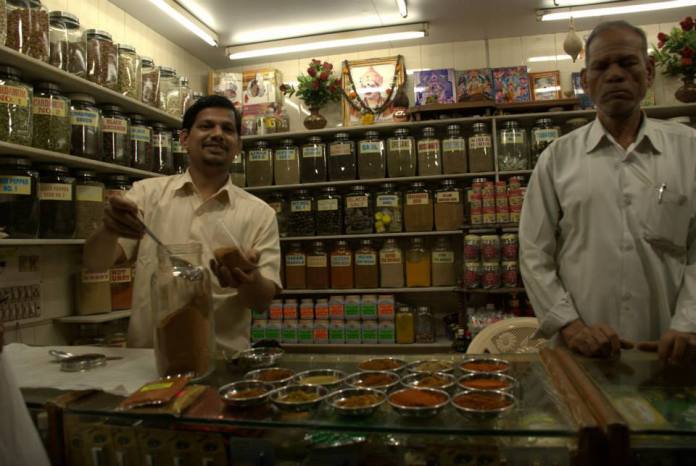
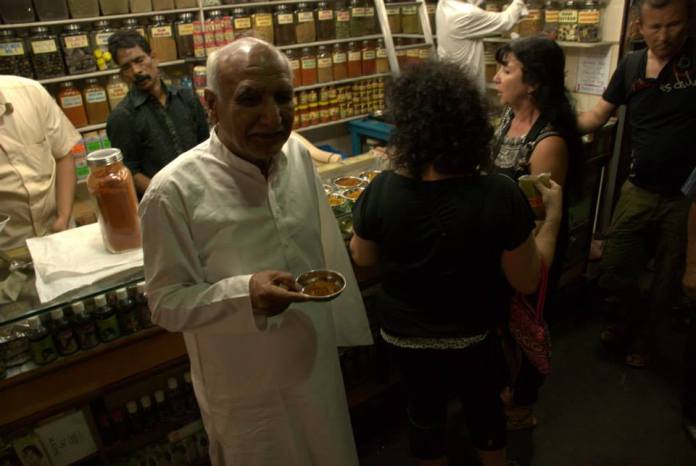
We passed counters filled with nuts, fruit, shampoos imported from far away lands. After about five minutes of walking we got to the end of a dimly lit alley, where two indians were packing masalas and curries for a couple of skeptical Europeans such as ourselves.  The “guide” as I like to call him, was dressed in a long, white kurta. His right arm had been cut off from the shoulder. His left arm, however, was sufficient for him to show us each type of spice in a tiny metal bowl. We were encouraged to try and smell all the spices: mild, sweet, spicy curry, masalas, digestives and many more. I bought a red curry and a masala, plus some chimen seed mouth freshner.

guide

“The “guide” as I like to call him…”

spices

“We were encouraged to try and smell all the spices…”

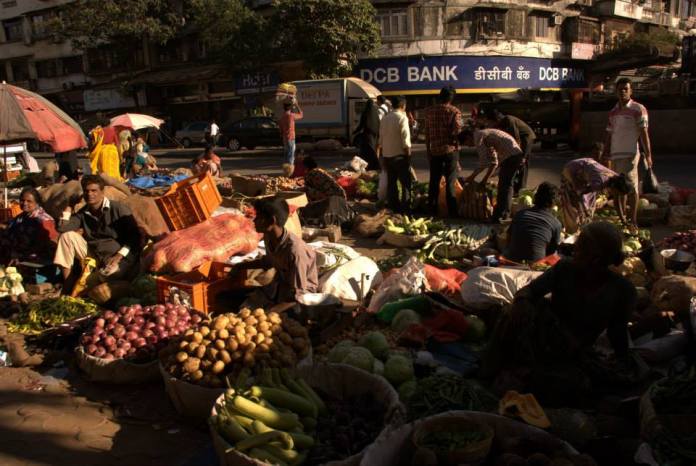
On our way back to the hotel, we took a few photos of the men and women selling vegetable in the streets. We also had a (respectful) laugh at the “holy cows”, who were slowly walking around as a sign of prosperity for the sellers. Needless to say, the fruit and vegetables were plentiful, which explains why so many indians are vegetarians.

market

“fruit and veg were plentiful…”

cow

Holy cow making sure the market is plentiful.

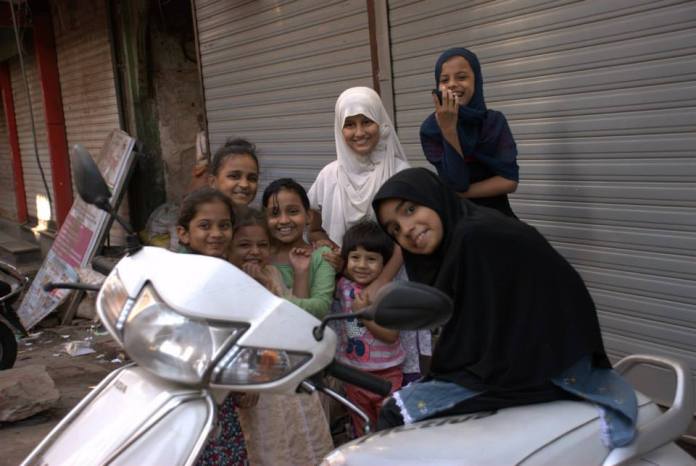
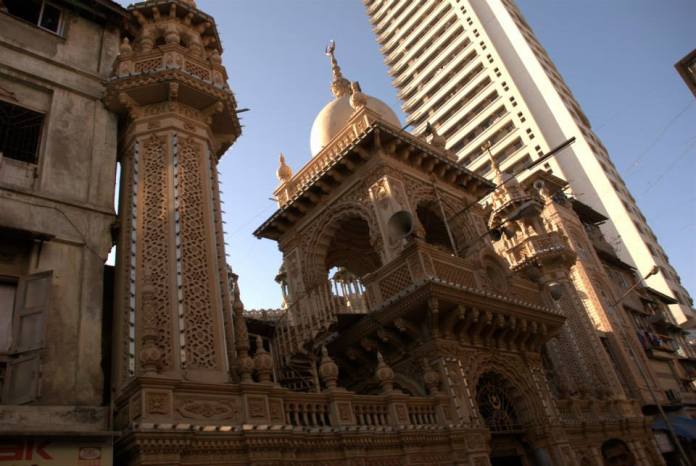
Many narrow roads led to the residential homes of hindu and muslim families living together in harmony. We took one of these roads to meet a small group of girls playing in front of a mosque. The holy place was beautifully carved in white stone, with many flowery ornaments. At the top of the mosque there were two large patephones, ready to transmit the daily mass. Although beautiful and inviting, the mosque was crammed between the old and deteriorating buildings of the residential area. It looked a bit like a jewel in the desert.

girls

“girls playing in front of a mosque…”

mosk

“It looked a bit like a jewel in the desert. “

***

On the 10th of February we had a lovely time with Raaj and his wife Priyanka. To be honest, after seeing the devastation from yesterday, I was grateful for a guided tour through the “pretty” places. My hopes were high, but not my expectations. Although Mumbai is a grand metropolis, it has the majority of its population living in poverty.

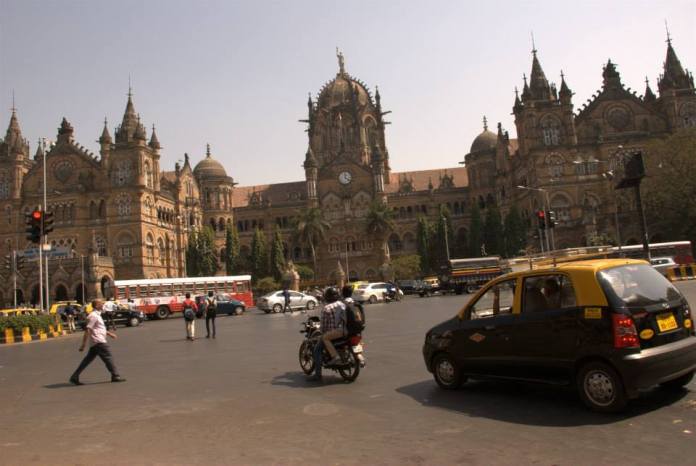
Raaj came to pick us up at around 11:30. A beautiful feeling of friendship filled our hearts as we ran to greet him. We hadn’t seen each other in over a year. A cab took us to the Victorian train station, where British and Indian architectures could be seen together.

Queen Victoria’s Train Station, libraries, colleges, a great clean, green, beautiful park filled with palm trees and young couples under the warm sun….lifted me up with hope and joy. Milto bought a few antique coins, while I contemplated the beauty of this part of the city. And, as Raaj pointed out, everywhere you look is full of people. For me, India is about the people and not the architecture.

train1

Queen Victoria Train Station.

coins

“Milto bought some coins…”

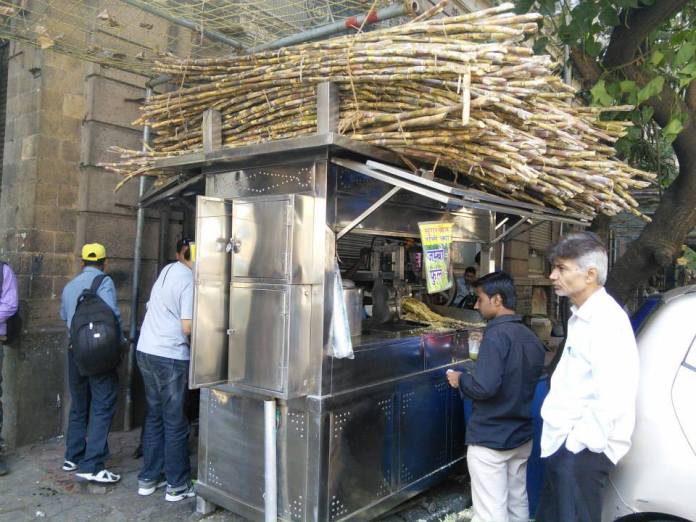
I tried some sugar cane juice from one of the many ambulant carts with 8 and 10 rupees signs flying in the wind. I felt wonderful, watching so many different types of people, all together under a roof of palm trees and banyans. Milto, Raaj and I then went for lunch at a place where both Asian and European cuisines were embraced. Milto could finally enjoy some plain food, as the menu so far had given her too many tears.

sugar

“I tried some sugar cane juice…”

After a good hour chatting to Raaj about the good old days at Bournemouth University and a yummy masala, he thoughtfully exclaims: “A beautiful lady is coming.” I turn around and there’s Priyanka, Raaj’s wife with a great grin on her face. She was carrying a large bag of gifts for us and for Akila’s wedding. We were so glad to finally meet her after all the time we had known Raaj.

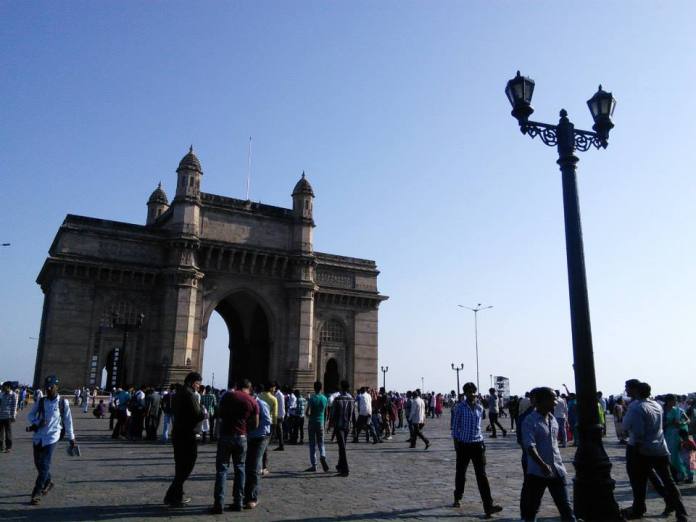
After lunch we took another cab to the Gateway of India, the border between India and the rest of the world. We were told that the giant stone arch by the ocean was the place where the English used to come through a while back. The great square in front of it was filled with walking sarees and photographers asking people to pose for them while holding the tip of Taj Mahal hotel, next to the arch.

gateway

Gateway to India and many, many people!

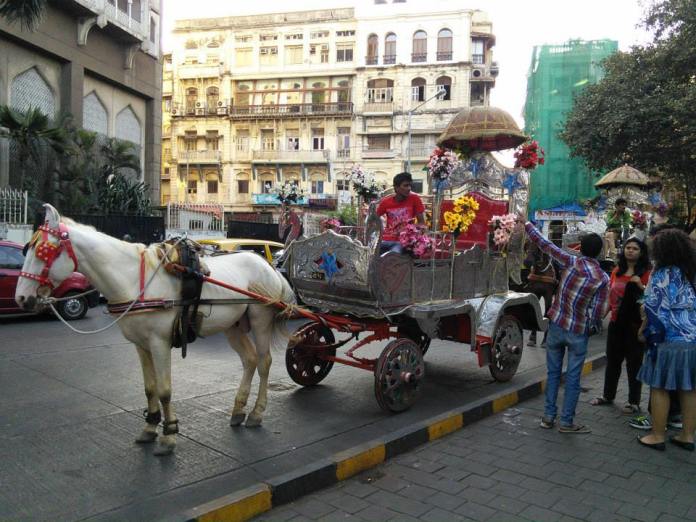
We walked around aimlessly for a while. Milto asked the silly: “Anamaria will you marry me?” question (inside joke, I said no). Nevertheless, we went on a tonga ride around the square to celebrate. The tonga is a silver carriage, with a white horse, a multitude of fake flowers and aromatic incense. It reminded me of the gipsies from back home. We got on it for 400 rupees, which is a fortune for the locals (about 4 pounds for us).

tonga

Stylish tonga ride.

Lastly, the four of us headed to the Queen’s necklace gulf. This beautiful place gets its name from the street lamps that form a necklace at night. We admired the sea at sunset and enjoyed a couple of cups of very sweet chai. We eventually went back to the hotel in a cab, which Priyanka ordered for us.

milto

Milto at the Queen’s Necklace gulf.

***

temple

“We took off our shoes and first entered in what looked like a small temple dedicated to a few gods…”

The 11th of February was a spiritual day, as Raaj called it. Me and Milto went to Mahalaxmi temple, where hindus worship the god Ganesha. The elephant god, as he is also known, had his father chop off his head in a misunderstood act of jealousy. When the father realized what he had done, he replaced his son’s head with an elephant head. Sounds plausible.

We took off our shoes and first entered in what looked like a small temple dedicated to a few gods, amongst which the holy cow was watching. Men would ring a bell as they entered the worship place. They would visit each god, which had its own statue in a tiny box room, and pray a few times by shaking their hands up and down.

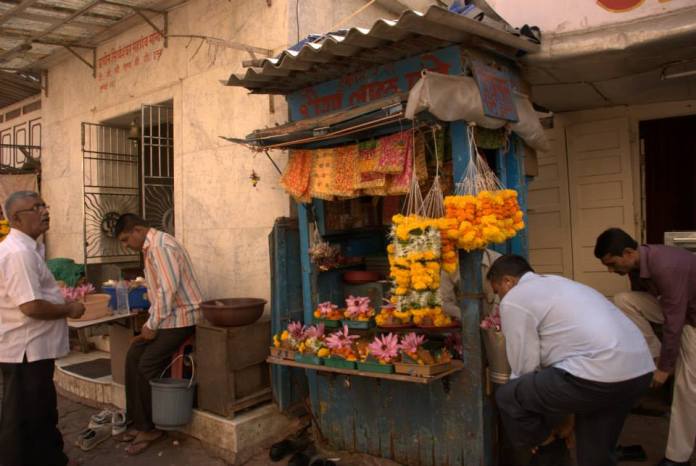
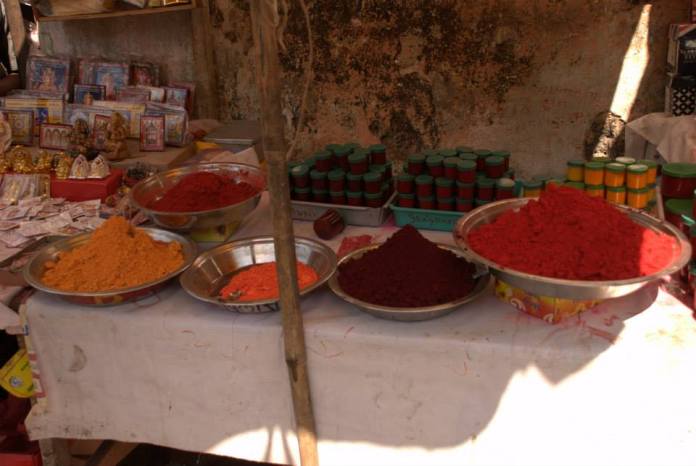
The larger temple was up a hill and the path to it was through a tiny market, where people were selling flowers, food, icons, god statues, coloured powder for worship practices. At the foot of the steps leading to the altar, we took off our shoes again and walked through security where we had to leave our cameras. Men and women were separated in long queues on either side of the offering altar. Women were bringing plates of flowers to a god with a dotted swastika sign on its forehead.

goods

“people were selling flowers, food, icons…”

prafuri

“colourful powders for worship practices…”

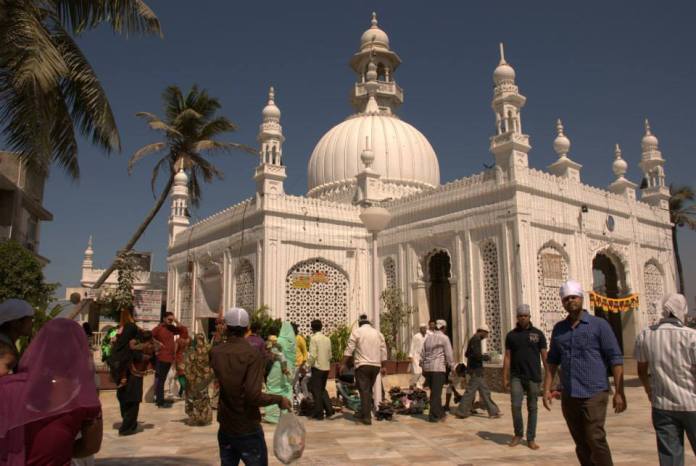
Our next temple was the Haji Ali mosque in the middle of the gulf. It shone bright in the sun as we walked towards it on the long and narrow pier, filled with merchants and beggars. The mosque had grand walls, engraved with models similar to the ones found on the little mosque near the market place. Inside, we had to take off our shoes, cover our heads and go left in a separate room designated for women. The men could be seen inside the altar, throwing and catching Mohamed’s holy canvases on what looked like a shrine. Two little girls came, stroking a couple of red threads, praying and tying them to the altar entrance. They urged me not to take photos there, as it was a holy place. I obliged. Outside the mosque, people were cooling down in the sea.

mosk1

“Haji Ali mosque in the middle of the gulf.”

mosk2

Haji Ali mosque.

beg

“merchants and beggars.”

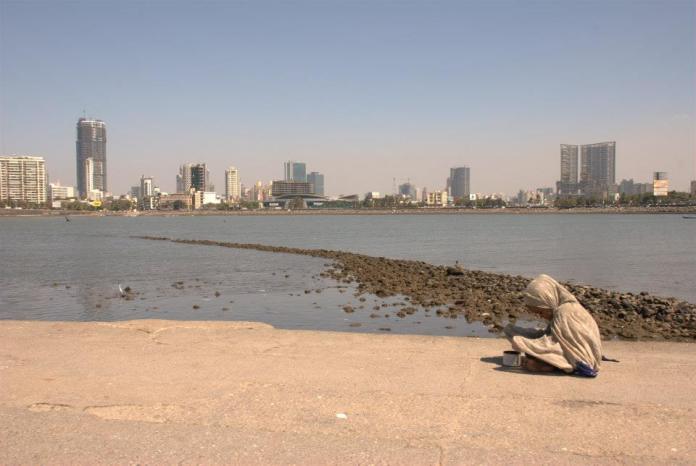
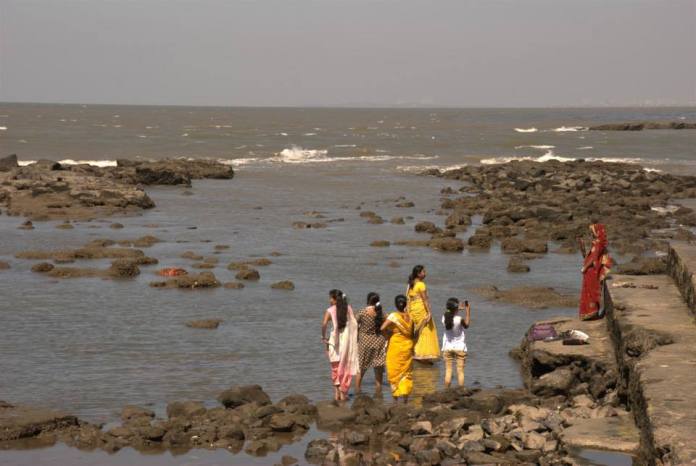
sea

“Outside the mosque, people were cooling down in the sea.”

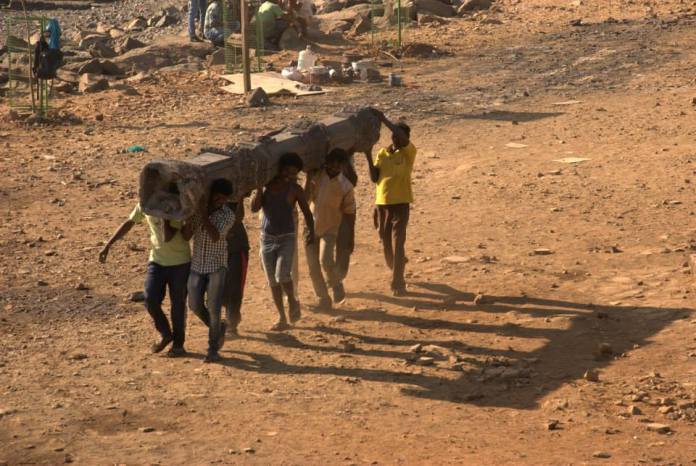
Our third, less religious place was the Branda Bandstand, where we met a few friendly Europeans who were teaching there for a month. Quite a few of the locals asked us to take photos with them as we looked out of the picture most of the time (we were white). A few men carrying a giant stone column were smiling at us as we took a photo of them. These people love to pose 🙂

carry

“These people love to pose :)”

There are many more memories from our stay in Mumbai, but I will leave it at this for now. Milto thinks her half a page is enough to describe our trip so far 🙂 Until next time!

Standard
Character Essences, Research & Coding

Expressing Emotions Through Procedural Animation

We know from Paul Ekman that there is a baseline for human emotions. We all express the 6 basic emotions (joy, sadness, anger, disgust, fear, contempt) in more or less the same way. This personal inquiry looked at how we can abstract emotions to a language of trigonometric functions. Is there a link between the energic, soaring joy emotion and the upwards movement of a sine wave? For this initial stage of the project, I used simple primitive geometry.


Abstract

The complexity of emotion and thought an individual can contrieve is far from being clearly defined. As the philosopher Winwood Reade suggests however, “while the individual man is an insoluble puzzle, in the aggregate he becomes a mathematical certainty”.  This statement reflects the idea of general available guidelines, common to all individuals, through which they connect and understand one another. These rules are also found in the area of expressing emotions. We can simply describe  basic patterns for anger, contempt, disgust, fear, joy and sadness, thus we can make an attempt in defining these templates in a mathematical form. The current study focuses on finding the appropriate elementary functions that contribute to creating, so called, target factors, which convey characteristics of the six aforementioned emotions.  

Project Links

This project was done during by MSc in Computer Animation and Visual Effects at Bournemouth University, under the supervision of Stephen Bell.  You can read our presentation here.

Standard
Chasing the Light, Stories, Voice Mountain

Voice Mountain – Ch. 2

(!) Read Chapter 1 here.

Ten years later …

‘Your hands are floating along the keys, Josephine. You don’t have enough precision.’

Josephine was now a young woman of only 17, sitting up straight onto a dark mahogany stool. She was wearing a white linen, frilly dress, which swooped all the way down to her knees. She immediately corrected her technique, intently studying the music sheet. Mrs. Sylvia Prackson was reclined in a green velvet armchair, with her legs crossed and tapping the timing with her right foot.

The large grandfather clock on the other side of the broad living room struck 9 am. Rays of sunlight splashed round spots of red, green and yellow through the stained glass windows. Only one set of windows was transparent and they also served the purpose of a set of doors towards a rose garden.

Mrs. Prackson raised from her armchair and with rhythmic footsteps, matching the grandfather clock’s ticking sound, walked towards the garden windows. She lifted a long, wrinkled, white hand to pull a small rope, residing next to the windows. They opened smoothly with a slight clicking sound every 5 degrees.

Josephine, who had been playing solemnly until that very moment, suddenly stopped. She turned to see the tall, slim figure of her music teacher, soaked in sunlight. Mrs. Prackson was facing the garden with her left hand on her hip and her right arm folded against the rim of the door. Josephine admired her bright blue silk dress, shining in the sunlight as she half turned and said, ‘I didn’t say stop. You still have 4 bars left.’

As she said that, Sylvia stepped into the garden, grabbing a pair of metallic scissors from  a little toolbox hung on the outside wall. Josephine finished playing the piece and then quickly turned again to see Mrs. Prackson returning with a small red rose. ‘Perfection!’ she exclaimed. ‘Behold a creature that  knows nothing of praise, but still manages to attain the measurements of the golden mean.’

Mrs. Prackson walked to a round mahogany table, with stained glass motifs encrusted in its top. She gently placed the rose in a thin, clear glass vase, with a spherical bottom. Her long fingers brushed over the bright petals as she dropped a round pebble of salts in the vase. She watched as it dissolved with a light hiss in clouds of grey fumes. In a matter of seconds, the water was still again and Sylvia turned towards Josephine.

‘You must return by the time this rose withers, or else your talents too, shall wither. I have cut this rose from its source to show you how important it is to stay connected to a moving system of parts that work together. No more absences!’ she ended.

The living room door suddenly opened with the same clicking noise as the garden doors. Sylvia’s right arm was stretched towards it at a perfect 90 degree angle. Her chin was raised and fixed, while her brilliant green eyes were following Josephine out of the room. ‘Thank you Mrs. Prackson!’ she whispered mechanically as the front doors in the hall adjacent to the living room also opened.

She curtsied and walked away in a rhythmic fashion, slightly out of sync with the grandfather clock. ‘Same time next week then’, she uttered as the front doors were closing in front of her.

Josephine turned around to see Blossom Square in a frantic, but also organized state. School children were running around with large leather backpacks, with more books than their little bodies could handle. Their mothers and, occasionally fathers, would follow them with measured steps and composed features, without the slightest glimpse of remorse or surprize.

‘Good day miss Arundel, may I say that your complexion is most exquisite today!’, said a young man of impeccable posture as he beamed confidently towards Josephine.

‘Charming as always, my good Mr. Tickson’, she replied diplomatically. ‘I hope that my spirit will follow through with my flawless outward appearance.’

‘Do call me Richard, I believe our acquaintance has exceeded the allowed time for pointless formalities. See you in class!’ he concluded with a sharp nod and went on his way with an energetic trot, that reminded Josephine of the metronome on top of Mrs. Prackson’s piano.

The cherry tree, in the middle of the square she now stood in, shone of sap green and golden hues, as autumn was starting its long reign. A small group of children was forming a circle around it, while a tall, elegant lady was measuring the radius, with the help of a foldable ruler.

‘Not much progress since last year,’ she uttered briskly. Her name was Monica Mathews and was the local school’s most acclaimed geometry teacher. Monica followed Josephine’s weary walk for a while and sighed to herself. ‘The angular velocity is disproportionate to the global displacement field,’ she said to herself and then turned 180 degrees on her toes. ‘What else do we need to measure today, children?’

A little girl, dressed in a checkered uniform, thrust her arm up in the air. ‘Yes Caroline!’ ‘We need to count the number of trees along the Cosine river, to ensure enough support is provided for the river bank.’

‘Very well done Caroline! You’ve been reading ahead. Indeed children, everything must be counted, measured and analyzed. If we have the data, we have control over our lives.’ The children nodded and followed lady Mathews in what looked like a miniature army march. Their backpacks were bobbing up and down, in an attempt to balance the weight of the many books inside.

Josephine was walking slowly towards the school, which resided in the east part of town. Her gaze lifted from the ground where she had been projecting her thoughts, to see the school entrance sign: “Arundel School of Sciences.” and the motto “A man without knowledge is like a tree without roots.” The school bore her family name as Josephine’s ancestry was one of great mathematicians, physicists and chemists.

The first half of a normal school day consisted of theoretical lectures, while the second half was dedicated to practical experimentation. Josephine’s feet turned towards lecture hall 301, where her father, Frederick Arundel, was waiting for his students. His field of study was Sensory Physics, the physics of the five senses. Optical Acoustics was his speciality and where he spent most of his life researching and publishing for national journals of Applied Science.

‘Welcome Josephine! I see you decided to join us today. The forest did not tempt you to study its path distribution?’

‘Father, you don’t always have to be so formal,’ Josephine replied with a hard sigh, as she took her seat, at desk 14A, in the middle of the class.

Every number had an exact purpose in Arundel school, even in the classroom.  The door number represented the advanced year and month the students were in. The seat number represented the current level of knowledge attained by the student. There were 10 years of study in the Arundel School: 4 for basic sciences, 3 for intermediate and 3 for advanced sciences.

Everyone was seated in respectful expectation. Professor Frederick was a very clear and confident speaker and knew all the most recent discoveries in his field. ‘A breakthrough has been made this week,’ he began, ‘Professor Gabriel Armitage from the Institute of Renewable energy in Brookcastle has created a perpetuum mobile.’

The class applauded in sync, creating a light echo around the classroom. ‘Since Valleycross is 30 miles away from Brookcastle, we are expecting to view a demonstration in the following month,’ he concluded with a slight sign of enthusiasm.

Frederick then turned on the spot and lifted a black board with acute precision. ‘Today we’ll be discussing how we can preserve and chanel the sounds we produce so that they can travel longer distances.’ His eyebrows broke into a realization and spoke more to himself than to his class. ‘With professor Armitage’s recent discovery, we will be able to apply the perpetuum mobile principles to sound propagation. Telephones will no longer be needed to communicate long distances.’

The alarm went off. Dark, grey clouds were cramming over the little village of Valleycross with urgency. The alarm sound was a combination of a thunder and a sharp ping sound that becomes irritating to one’s ear after a long period of time. Everyone rose without a word, almost like someone had shot them out of their seats at the same moment.

‘A storm is coming. The weather forecast was inaccurate today. I’ll have a word with the meteorology department as soon as possible. For now, please take your student cards and proceed to the emergency bunker on level -3 and wait there for instructions.’ Everyone turned 180 degrees, except Margaret Button, a plump, red haired girl with rosy cheeks and teary eyes. ‘I can’t find my student card’, she pleaded, visibly worried.

Frederick clenched his teeth slightly, but answered calmly. ‘You won’t find it in a rush. Head down with the others and we’ll see what we can do.’ He stomped his right foot twice to grab Margaret’s attention, who was still rummaging in her bag. She saw his left arm lift at a 90 degree angle towards the door, with a subdued, encouraging smile. Margaret wiped her tears quickly and jogged out of the room to join the others.

The bunker was a set of three underground floors, made of a corrosion free metal alloy. Each level was made for each of the school’s expertise levels, basic, intermediate and advanced. Students would travel between the different levels by using the large square lift in the middle of the school. It could carry up to 50 people and was powered by four furious pistons on each level. The lift walls were made of brass, with a door on each side. The school’s emblem, of a sparrow flying along the golden spiral, was encrusted in the door which faced the main entrance on the ground floor.

Floor three filled up the lift and waited patiently for it to descend. As soon as they got to level -3, the doors opened like a swift cut of the knife in all four directions. Students divided with staggering precision into four groups of equal number. Each group chose the closest exit from the lift and walked towards the empty, dark space in front of them.

On each side of the room a row of cone lamps was illuminating a set of red wooden doors. Each door had a student name on it, engraved in a sliding brass plates. The lift had left the students staring at the doors in expectation. As it raised its body of brass, it revealed a giant round clock in the floor. The ticking movement pulsed from under a thick layer of transparent glass. 

Josephine knew it would only take five minutes before the professors in charge of level 3 would descend. Their doors were light grey, with golden plates. There were two of these doors on each side of the room, one on the far left and one on the far right of the wall. 

Time passed slowly and in the stillness of the room Josephine could only hear Margaret’s light sobs. She went to her, trying to avoid the harsh stares of her colleagues. 

‘Why are you so distressed, Margaret?’ she whispered when close enough.

Margaret jumped an inch and also whispered. ‘I cannot get in my room, I don’t have my student card.’ She then suddenly turned to face Josephine, who had crept up behind her. ‘I know what happens to students who cannot access their bunker room. They send them out into the storm and make them run to the collection centre, at the Northern Laboratory.’      

‘What’s so bad about a storm?’ Josephine laughed rather loudly.

‘Shush!’ snapped a voice next to her. ‘Josephine, you act as if you don’t know it’s a collection day today.’ This was the voice of Albert Prackson, her piano teacher’s son. He had his mother’s figure and his father’s grave voice. He was fascinated by forms of energy, which might explain his eternally frizzy hair and bright emerald eyes. 

Josephine gave him a nudge and smiled. ‘Thanks for the reminder, I’m completely lost these days. It’s just strange that they have collections so often now.’ 

‘They want to harness the lightning power while the atmosphere is still warm from the lingering heat of the past summer.’

‘You talk poetry, Albert,’ she laughed.

‘Don’t be ridiculous!’ he grunted and resumed to keep silent, with his hands tied together in front of him. 

‘Here, have my card Margaret.’

Josephine put her student card in Margaret’s front pocket. ‘What are you doing?’ she gasped. ‘Do you want to be burnt by their experimental lightning procedures? 

‘That is quite a mouthful,’ she said while eying the clock. ‘Don’t touch the top shelf collection while you’re in there, mind you! Well, see you later.’ 

‘But what if…’ 

‘We get caught? You can tell them it was my idea.’

Josephine ran to the middle of the room, where the clock ticked gently. Four metal ropes surrounded it and were now vibrating slightly. Besides each rope there was a round floor button, made of green marble. ‘I’m hope I’m not too late,’ she sighed, while stepping on one of the buttons. The brass lift came promptly down and Josephine stepped in, under the confused gazes of the half turned students in the room.   

Rain was pouring down with strength. Rolling thunder accompanied blinding light over the village houses. Josephine was running across Blossom square with a look of victory on her face. She stopped for a moment under the cherry tree, listening. A subtle buzzing noise could be heard amongst the heavy drops. ‘They’re warming up the collectors,’ she thought and leapt forward with a jolt. 

Her feet took her south, towards the forest. This was as far away from danger as she could fathom. Electricity was usually collected at a large condenser in the Northern Laboratory. The road was empty, but for the trickles of water, making their way through the cobblestones. Josephine was already drenched in the cold late summer rain. She hurried her steps with confidence, however, as she knew of a place where she could find shelter. 

As Josephine approached Cosine river, lighting broke the dark clouds. She stopped. A light whisper, like a bird’s song, came swiftly through the trees. Lighting broke again. The rim of an ominous mountain revealed itself in the sharp blaze for a moment. Its dark blue crests sprung from the heart of the forest like a swollen wave, from the depths of the sea. Josephine listened very carefully. The song had stopped, but she could now hear a murmur. ‘It must be the wind through the leaves,’ she thought. 

She crossed the stone bridge into the forest and was soon surrounded by tall pine trees and stout oaks. After a few minutes of walking briskly along the marked path, Josephine broke off to the right. She had a particular tree in mind, an old oak, with a girth the size of a small hut. As soon as she reached it, the murmur of the forest grew into an eerie echo. The sound of drums followed. Thunder bellowed and with it a myriad of sounds emerged from the heart of the mountain standing now in front of her. Josephine looked up with wonder and fear. In the mist of the downpour she could only see the sharp, desolate crests of the mountain against the velvet sky.  

A loud echo resounded through the trees, followed by light, enchanting human voices. Lighting struck the oak tree which had been her momentary protector from the rain. One of its branches fell on Josephine. As she closed her eyes under the shock of the blow, Josephine could make out the figures of men on the crests of the mountain.  

‘Josephine, wake up!’

Frederick was gently shaking his daughter out of what had seemed like an eerie dream.

‘The little people on the rocks,’ she murmured.

Frederick started to pace along the hospital bed. His footsteps created a rhythmic pattern, contrasting with the now soft rain outside. He turned to face the window.

‘You can’t just leave the school during a collection Josephine,’ he started gravely. ‘I’m very disappointed in you.’ 

Josephine tried sitting upright slowly, but an aching lower back pain held her in place. ‘There was hardly any danger of a shock, father. I’m surprised that the physics department aren’t having a field trip during a lighting storm.’

‘There have been meetings on the topic and we can’t take the risk, however small,’ he muttered mechanically. Frederick looked at his shoes and for the first time in what seemed like a decade broke into a deep sigh. ‘Don’t get up!’ he urged as Josephine lifted her head in wonder.

‘Your mother died in a lighting storm,’ he finally managed to utter. ‘You were very young, and probably have little recollection of it or of her, for that matter.’

She could hear his words fading, as if under a heavy burden. 

‘I remember her singing.’

Frederick’s eyebrows broke into a frown for a split second.

‘I’ve never heard singing since then. Well, not by a human voice, at least, and birds seldom come in these parts.’

‘She called it a science experiment,’ he smiled bitterly. ‘Her hypothesis was that music made by the human body had the quality of accessing deeper information than what the mind can provide. She even went as far as to proclaim the existence of a soul, which caused quite a commotion amongst the science committee members. Song taps into the heart, my Sarra used to say.’

‘Is it so very wrong?’ Josephine stammered as if wanting to sieve her words as they came rushing out of her. ‘To have a soul, I mean. Surely by now science has proven that not everything can be proven.’

Her cheeks burnt with curiosity and bashful sincerity. Frederick paced once more and then stopped to look at his daughter.

‘It is true that much knowledge is lacking from our minds. Inventions and theories have been swallowed by time, ignorance and violence. I am sure science would have held a much higher rank, were it not for four world wars and two civil wars. Much truth has been lost in fires or stolen by individuals of little consequence for intellectual growth.’

‘Are you saying that we haven’t had the time to prove everything,’ she uttered resentfully.

‘Nor ever will we have the time to prove everything,’ he concluded with an academic demeanour. ‘Josephine, you must understand that rational, logical thinking, detached from any form of passion or emotional impulse is the only certain path that can sustain human life on this earth. If one gives in to whims and fancies one is undoubtedly on a road of being bound to irrational, sometimes dangerous pursuits.’

‘Father, you are implying that mother’s theory was a mere whim.’ 

‘In some sense, it was,’ he resolved. ‘And you are not to follow in her footsteps. Continue with your studies and build your theory of the world on solid solid ground, not on grains of sand. I’ll let you rest now. I’ll be back tomorrow to bring you home.’

‘I miss her,’ she said, tears running down her rosy cheeks. 

Frederick was on the doorstep, with his back towards the girl. ‘Cry now, but I wish to see you refreshed by tomorrow.’ He then stepped out, with the door closing behind him with a ticking noise.
Standard
Chasing the Light, Essays, Stories

Chasing the Light

Light flowed gently over the serene face of the newly baptized child. Her golden curls crowned a carefree smile as she grabbed her godmother’s finger. Soft spoken babbling soon followed. Clouds of incense mixed with the colours of stained glass as they rested with sighs of rested hearts.

‘Grija cea lumeasca sa o lepadam.’ I can’t remember the words in english, although I sung them today. What is the heart and why does it beat unceasingly? Why does it tremble with awe when we see a blossomed valley in spring? Why does it become light with joy when we see the face of a loved one? Or why does it sink in the depths of our ocean when we grief or feel unloved.

What are you running for? Or should I ask, who are you running from? Is it yourself or the lurking shadows of your soul? Who are you…really? Are you stardust or a grain of sand? ‘In veselie omul exista, se misca.’ A beloved father who lived by the sea used to say that. He means that joy is the natural state of a person’s heart. When you love someone, you give them your time, you rest in them and they rest in you. We run because we need to feel worthy of rest, we need to feel worthy of love.

‘Every person needs to learn from childhood how to spend time with oneself.’ Who said that? Ah, it was a russian boy with a warm heart and a keen eye. He’s famous now, but I believe he wants to be remembered by his stories, more than by his name. Silence is truly wonderful for listening. In order to be silent one must stop running.

‘Here you are, Izabella.’ her mother said as she helped godmother put on Izabella’s white, frilly dress. Izabella giggled with the all knowing laugh that only children have. The echoes filled the church and softened its grey stone walls. It hoped to hear the little girl’s laughter more often in the future. She could play on its worn out persian rugs and it could shelter her from the rain and the world. The church wanted Izabella to rest in it. They could sit in silence together and think of matters of the heart. Because when you can be silent with someone, it is truly special.

light

Standard
Acting & Improv, Character Essences

The Logic of Movement

A year ago I went to a workshop called The Logic of Movement with Stephen Mottram, an amazingly gifted puppeteer. He showed us how each character has a unique movement code that defines its personality. ‘A piece of cloth can move like a chicken’, he said and also showed us, as we gaped in amazement. Now, as I’m writing about handmade characters in my thesis, I came across some of his work from 1990, Animata.

I’m sharing one of the videos here. I find it fascinating that a simple set of ping pong balls can create such complex characters in our minds. This is DEFINITELY an area of great interest to me, as a future independent researcher.

Standard
Character Essences, Research & Coding

Curious Cones

This little project aims to create a random set of cones that “look at” a shiny red sphere passing by. The reference below shows the original maya + python youtube tutorial. The code that follows was saved as 2 shelf tools which can be used with any mesh.

The first script (randomInstances.py) creates 30 instances of the first object selected in the scene. These instances are then randomly positioned, rotated and scaled.

#randomInstances.py
import maya.cmds as cmds
import random
random.seed(1234)
result = cmds.ls(orderedSelection = True)
print 'result: %s ' %(result)
transformName = result[0]
instanceGroupName = cmds.group(empty = True, name = transformName + '_instance_grp#')
for i in range(0, 30):
   instanceResult = cmds.instance(transformName, name = transformName + '_instance#')
   cmds.parent(instanceResult, instanceGroupName)
   tx = random.uniform(-10, 10)
   ty = random.uniform(0, 20)
   tz = random.uniform(-10, 10)
   rotX = random.uniform(0, 360)
   rotY = random.uniform(0, 360)
   rotZ = random.uniform(0, 360)
   sXYZ = random.uniform(0.1, 1.25)
   cmds.move(tx, ty, tz, instanceResult)
   cmds.rotate(rotX, rotY, rotZ, instanceResult)
   cmds.scale(sXYZ, sXYZ, sXYZ, instanceResult)
cmds.hide(transformName)
cmds.xform(instanceGroupName, centerPivots = True)

The second script(aimAtFirst.py) takes the first elements selected and sets it as a target, while the rest of the elements selected are set as sources, looking at this target along their Y axis. At least one source and one target must be selected in order for the algorithm to work.

#aimAtFirst.py

selectionList = cmds.ls(orderedSelection = True)
if len(selectionList) >= 2:
   print 'Selected items: %s ' % (selectionList)
   targetName = selectionList[0]
   selectionList.remove(targetName)
   for objectName in selectionList:
      print 'Constraining %s towards %s ' %(objectName, targetName)
      cmds.aimConstraint(targetName, objectName, aimVector = [0, 1, 0])
else:
   print 'Please select 2 or more objects'

Reference: Autodesk Scripting on Youtube

Standard
Thoughts About Life

Dancing

It’s 1:19 AM and my ears are still pounding with throwback music from Moles. Believe it or not, this is the first time I went there in my 3 years of living in Bath. The music was not bad, it was nice to hear some oldies but goldies from the 90s and 80s. I love dancing, I love telling a story with my arms, while my feet tap the rhythm. I like to dance like no one’s watching, which might upset a few people who need their personal space and make one or two hen party girls jealous.

Dancing is a form of acceptance to a group. I got accepted in a couple of them, with smiles and encouragements from strangers. But I would always sneak away to some other corner of the room. It’s almost like I didn’t feel I belonged to any group as I prefer dancing on my own. Isn’t that a metaphor for life? A couple of Las Vegas looking lovers kiss after a mad dancing routine. Haha, they thought they were the best dancers here…but then I came along 🙂 Enough not so humble bragging, let’s get to the point.

Dancing is not just a form of socializing, being accepted in a group or showing off your calves. It is a form of expression. What can you express? Who you are, how you connect to people, what you feel. Music is the paint, you are the painter. If the paints you are given cripple and fragment before your very eyes with repetitive beats, that don’t mean anything, how are you to paint your masterpiece? DJs, give young people good music to dance to, so that they can feel what a person lived through their song and reflect it with their own expression and experience. Does that make sense?

There was only one song when I felt truly alive. I can’t remember its name, I just remember what I saw as my feet drummed the floor with the patterns of a raindance. I saw the deep rainforest and a leopard’s deep, dark eyes staring back at me. It was telling me I need to live. In order for one to live, one needs to cling on to what is worth living for, friendship, love, adventure, true, meaningful connections, their Creator and really good music.

Standard
Sketches and Paints

Transcendence of the Lilac Tree

transcendence_small

Transcendence of the Lilac Tree (Wax crayons)


I made this sketch in the Botanic gardens in Bath on a soothing August morning. The ladden lilac tree seemed to rest so calmly in the sunlight. I did not have green crayons to draw the stems, so I went for the golden one. This quickly inspired the angel carrying the burden and the beauty of these flowers. I wonder how many angels carry our own burdens and beauty every day.

Standard
Anam Fiain, Poetry

Bravery of Dawn

by Anam Fiáin of House Gideon*

A brave tale of knighthood I shall tell
That speaks not of blood stained swords or spells that repel
Nor does it speak of the shields that crush hearts of stone,
But of the courage of a man who is truly alone.

You have been sent to the bleakest abyss,
Where madness and darkness are never amiss
And if your brother raises his sword before you with death
Spare him his life and leave him his breath.

Be not afraid of those who can kill
A body of flesh as it can again heal,
Take heart, have courage and bare all with faith
And let not one soul become a wandering wraith.

Your brother will wake and morrow will ring
Of clinging voices who have forgotten their sting,
Heartfelt songs will replace the harsh and cruel zeal,
Saying: “My brother spared me so now I may heal.”

* Anam Fiáin is a character I created for an Empire LARP event

Standard